


Introduction
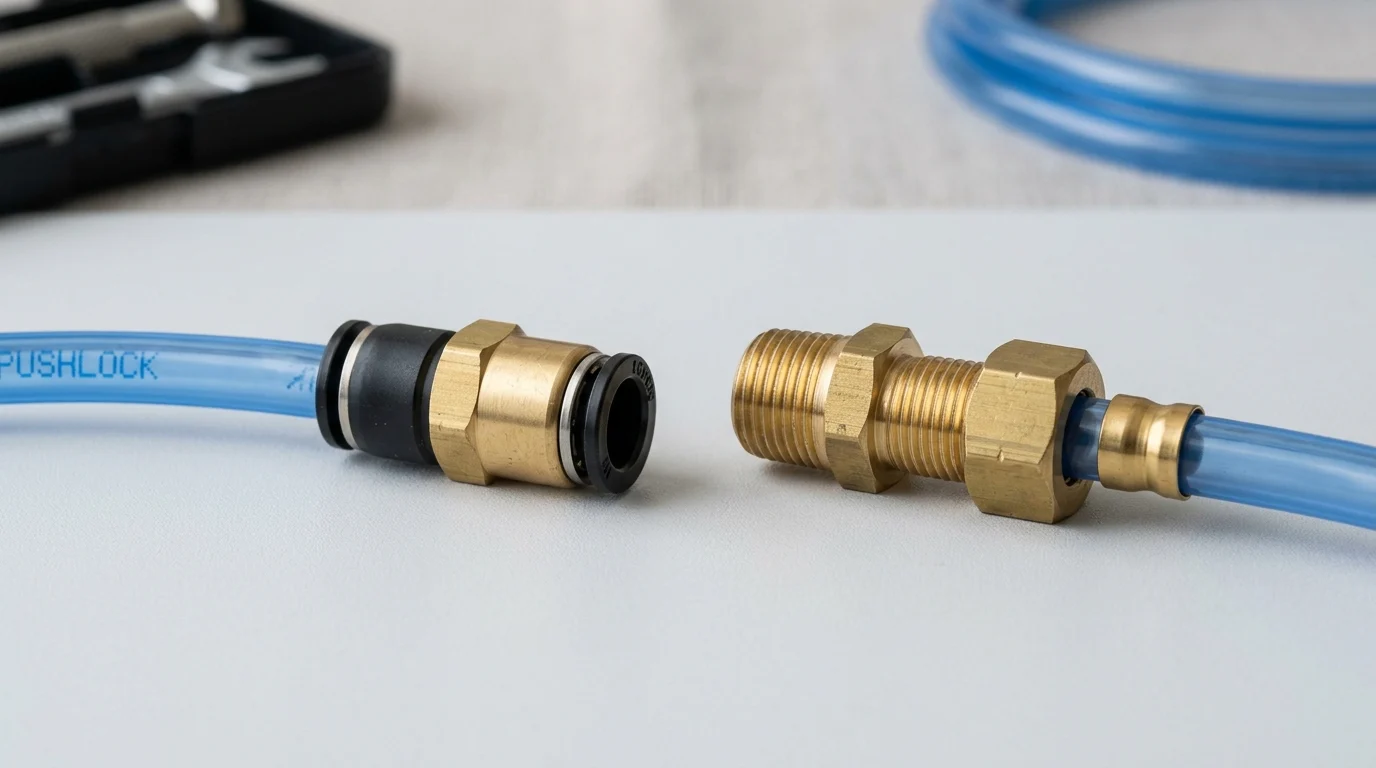
For fleet operators, the choice between push-lock and compression fittings affects more than parts inventory—it shapes installation time, repair consistency, leak risk, and how long a truck sits out of service. In air brake and other pneumatic systems, even a small connection failure can turn into roadside service, missed deliveries, and higher labor costs. This article compares push-lock and traditional compression fittings in practical terms, focusing on assembly speed, serviceability, durability, and DOT-related considerations. By the end, you’ll have a clearer basis for deciding which fitting type better supports uptime, maintenance efficiency, and total operating cost across your fleet.
Why the Push Lock Fitting vs Compression Fitting Choice Matters
Commercial fleet maintenance operates on a razor-thin margin of error where vehicle uptime directly dictates profitability. At the heart of pneumatic brake systems lies a seemingly minor component that exerts a disproportionate impact on fleet reliability: the air brake fitting. The ongoing debate surrounding the push lock fitting vs compression fitting is not merely a matter of mechanic preference; it is a strategic decision that influences labor allocations, roadside service frequencies, and ultimately, total operational costs.
Pneumatic networks are the lifeblood of heavy-duty vehicles, governing braking power, air suspension, and transmission shifting. As regulatory scrutiny under the Department of Transportation (DOT) remains stringent, selecting the optimal connection method for nylon air brake tubing requires a comprehensive understanding of both systems. Fleets must weigh the traditional reliability of mechanical compression against the rapid assembly advantages of modern push-to-connect technologies.
Labor hours, roadside service exposure, and downtime
The most immediate operational difference between traditional compression and push-lock fittings lies in the labor hours required for installation and maintenance. A standard commercial vehicle can feature upwards of 100 individual pneumatic connection points. When utilizing traditional compression fittings, a technician must cut the tubing, insert a brass support stiffener, slide on a ferrule or sleeve, thread the nut, and apply specific torque using wrenches. This process typically consumes 30 to 45 seconds per joint under optimal shop conditions.
Conversely, push-lock fittings reduce this process to a single, fluid motion. After achieving a square cut on the nylon tubing, the technician simply pushes the line into the fitting until it bottoms out against the internal tube stop. This takes approximately 3 to 5 seconds per joint. During a comprehensive air system overhaul or a major valve replacement, this time differential compounds rapidly, saving hours of highly burdened shop labor.
Beyond the maintenance bay, roadside service exposure represents a severe financial drain. Commercial roadside repair rates frequently exceed $150 to $200 per hour, not factoring in the lost revenue of a sidelined asset. If an air leak triggers a system pressure drop that engages the spring brakes, the vehicle is immobilized. Minimizing the time a driver spends waiting on the shoulder of a highway depends heavily on how quickly a service technician can isolate and replace a compromised air line connection.
Why maintenance teams are reevaluating fitting choices
Maintenance directors are actively reevaluating their fitting standardization strategies due to shifting demographics within the diesel technician workforce. The industry is currently navigating a well-documented shortage of senior mechanics, leading to a higher reliance on entry-level or less experienced personnel. Traditional compression fittings are highly sensitive to technician technique; they require an inherent "feel" to avoid under-tightening, which causes immediate leaks, or over-tightening, which crushes the nylon tubing and creates a delayed failure point.
Push-lock fittings fundamentally engineer the human error out of the installation equation. Because the sealing mechanism relies on an internal O-ring and a stainless steel grab ring rather than mechanical torque applied by the user, the connection is either fully seated and secure, or it is not. This binary installation state allows maintenance teams to achieve highly repeatable, consistent seals regardless of the technician's experience level.
Furthermore, modern fleet operations are increasingly driven by data. As telematics systems become more adept at monitoring air compressor duty cycles and detecting micro-leaks in real-time, maintenance teams are being alerted to pneumatic inefficiencies long before a catastrophic failure occurs. This heightened visibility into air system health is forcing fleets to abandon "good enough" legacy practices in favor of fitting technologies that offer the highest initial seal integrity and the lowest total cost of ownership.
DOT Push-Lock vs Compression Fittings: Requirements and Key Differences
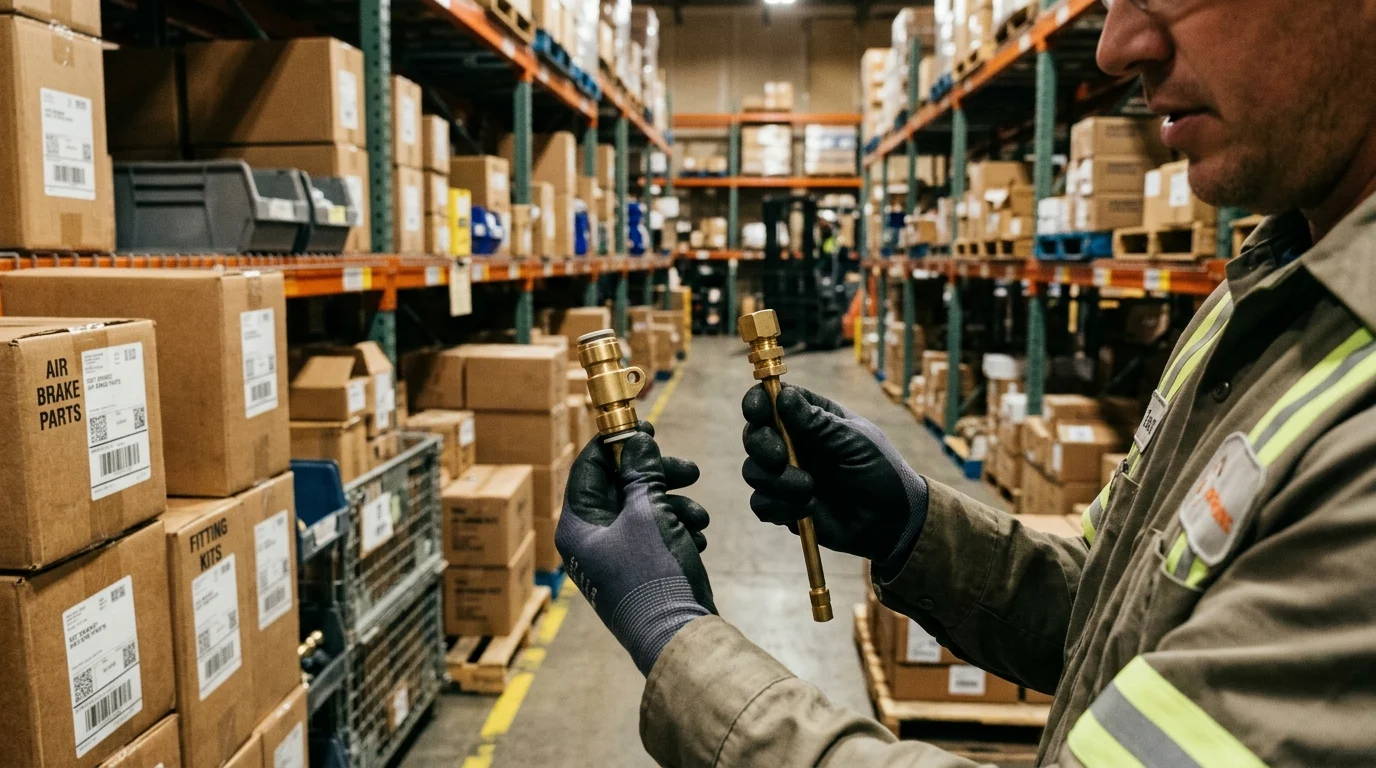
To legally operate on public highways, any component utilized in a commercial vehicle's air brake system must meet rigorous federal standards. Specifically, both push-lock and traditional compression fittings must comply with the Federal Motor Vehicle Safety Standard (FMVSS) 106 and the Society of Automotive Engineers (SAE) J2494 specifications. These mandates ensure that fittings can withstand the extreme pressures, temperatures, and mechanical stresses inherent to heavy-duty transport.
While both fitting types can achieve full DOT compliance, the engineering principles they use to secure the tubing and maintain an airtight seal are fundamentally opposed. Understanding these mechanical differences is critical for specifying the correct component for specific vehicle zones.
Installation and service requirements
Traditional compression fittings rely on mechanical deformation to create a seal. The installation requires three distinct sub-components: a brass body, a compressible ferrule (sleeve), and a compression nut, alongside a rigid brass insert that prevents the nylon tubing from collapsing. When the nut is tightened, it forces the ferrule into the tapered body of the fitting, compressing it radially against the tubing. For standard 3/8-inch nylon air lines, manufacturers typically recommend a torque specification of 12 to 15 foot-pounds to achieve optimal compression without compromising the tube wall.
DOT push-lock fittings, often referred to as push-to-connect (PTC) fittings, utilize a tool-less internal gripping mechanism. The body of the fitting houses a pre-lubricated elastomeric O-ring for sealing and a stainless steel collet (grab ring) with angled teeth. When the tubing is inserted, it passes through the O-ring and expands the collet. Pulling back on the tubing causes the collet teeth to bite into the nylon exterior, while system air pressure further forces the collet backward, tightening its grip. Servicing these fittings requires pressing a release collar inward to disengage the teeth, allowing the tube to be withdrawn.
The serviceability of both systems differs significantly in austere environments. A traditional compression fitting can often be reused by cutting off the crushed portion of the tube and installing a new ferrule and insert—provided the technician has these specific small parts on hand. Push-lock fittings, such as specialized DOT fittings, can be coupled and uncoupled multiple times without replacing internal components, provided the tubing end remains unmarred and perfectly round.
Technical variables that affect performance
Several technical variables dictate the real-world performance of pneumatic fittings. The primary variable is operating pressure. Standard commercial air brake systems operate between 100 and 135 PSI, with safety relief valves typically set at 150 PSI. Both DOT-approved push-lock and compression fittings are generally rated for up to 250 PSI, providing an ample safety margin for pressure spikes.
Tube preparation is a highly critical variable that affects each fitting type differently. For push-lock systems, the cut angle of the nylon tubing is paramount. The cut must be exactly 90 degrees (perpendicular to the tube axis). If the tubing is cut at an angle, the sharp edge can lacerate the internal O-ring during insertion, or it may fail to seat evenly against the tube stop, resulting in a slow leak. Compression fittings are slightly more forgiving of imperfect cuts because the seal is formed by the ferrule compressing the outer wall of the tube, rather than the end of the tube resting against an O-ring.
Another variable is tube ovality. Nylon tubing stored in tight coils can become slightly oval-shaped. While the rigid brass insert used in compression fittings actively forces the tubing back into a perfect circle during installation, push-lock fittings rely on the internal O-ring to conform to the tube's shape. Extreme ovality can sometimes compromise the initial seal of a push-lock fitting until system pressure forces the tubing to round out.
Side-by-side comparison of both systems
To clearly illustrate the operational trade-offs between the two technologies, fleets must evaluate them across several distinct mechanical categories. The following table breaks down the core differences between traditional compression and DOT push-lock systems.
| Feature / Metric | Traditional Compression Fittings | DOT Push-Lock Fittings |
|---|---|---|
| Sealing Mechanism | Mechanical deformation of brass ferrule | Elastomeric O-ring and internal tube stop |
| Retention Method | Threaded nut and internal brass tube support | Stainless steel collet (grab ring) teeth |
| Installation Time | 30–45 seconds per connection | 3–5 seconds per connection |
| Required Tooling | Tubing cutter, dual open-end wrenches | Tubing cutter only (tool-less connection) |
| Torque Sensitivity | High (prone to over/under-tightening leaks) | None (binary insertion: seated or unseated) |
| Reusability | Low (requires new ferrule/sleeve replacement) | High (can be released and reseated multiple times) |
| Vibration Tolerance | Moderate (nuts can loosen over high mileage) | High (collet grip strengthens under tension) |
This side-by-side analysis highlights why the industry is experiencing a paradigm shift. While traditional compression provides a brute-force mechanical bond, the speed, vibration resistance, and elimination of torque variables make push-lock systems highly attractive for modern assembly and repair protocols.
Risk, Compliance, and Failure Modes
In the commercial trucking sector, an air leak is not merely an operational nuisance; it is a critical safety hazard and a direct compliance violation. The Federal Motor Carrier Safety Administration (FMCSA) empowers inspectors to place vehicles out of service (OOS) for compromised braking systems. Consequently, understanding the specific failure modes and risk profiles of different fitting types is essential for fleet compliance managers.
While both push-lock and compression fittings are designed to outlast the typical lifecycle of the vehicle's pneumatic tubing, environmental stressors and improper maintenance practices can induce premature failures. Analyzing how and why these connections fail provides a roadmap for mitigating downtime.
DOT compliance and inspection considerations
During a Level I DOT inspection, enforcement officers conduct a rigorous evaluation of the air brake system. A critical phase of this inspection is the air loss rate test. Under FMVSS 106 guidelines, once the air system is fully charged and the engine is shut off, a single vehicle cannot lose more than 2 PSI per minute with the brakes released, and 3 PSI per minute with the service brakes applied. For combination vehicles (tractor-trailers), the thresholds are 3 PSI and 4 PSI per minute, respectively.
Audible air leaks at fitting connection points are one of the most common triggers for a DOT violation. Because compression fittings rely on threaded nuts, they are susceptible to backing off due to harmonic chassis vibration over hundreds of thousands of miles. If a DOT inspector hears an audible hiss from a loose compression nut at a commercial weigh station, the vehicle may be immediately grounded until a mobile repair unit can retorque or replace the fitting.
Push-lock fittings inherently resist vibration-induced loosening because they lack external threaded nuts on the tube-connection side. The internal stainless steel collet maintains constant tension against the nylon tubing. As system pressure fluctuates and the chassis vibrates, the collet's grip dynamically adjusts, significantly reducing the risk of spontaneous, vibration-related air loss during transit.
Effects of temperature, contamination, and repeated service
Commercial vehicles operate in brutal environmental conditions, exposing pneumatic fittings to wide temperature fluctuations and harsh chemical contaminants. DOT-approved fittings must maintain seal integrity across a temperature band ranging from -40°F to 200°F (-40°C to 93°C). Extreme cold causes nylon tubing to contract and harden. In push-lock fittings, high-quality elastomeric O-rings (typically Buna-N or Viton) are engineered to remain pliable at these sub-zero temperatures, maintaining the seal against the contracted tubing.
Contamination presents a unique challenge. Winter road treatments, including magnesium chloride and harsh de-icing chemicals, can accumulate on the chassis. For compression fittings, these corrosive agents can seize the brass threads, making future service nearly impossible without cutting the line entirely. For push-lock fittings, heavy accumulation of dirt, grit, or dried mud around the release collar can prevent the collar from fully depressing, complicating the release of the tubing during maintenance.
Repeated service also degrades connection points. Every time a compression fitting is overtightened, the brass ferrule bites deeper into the nylon tubing, eventually compromising the tube wall and causing a structural blowout. Push-lock fittings can handle repeated insertions, but if a technician repeatedly inserts a dirty, grit-covered tube end into the fitting, the abrasive particles will eventually score the internal O-ring, leading to micro-leaks.
How failure modes differ between fitting types
The failure modes for these two technologies are distinct and require different troubleshooting approaches. Compression fitting failures are predominantly mechanical and operator-induced. Approximately 70% of compression fitting leaks in commercial fleets are traced back to improper torque application. Under-torquing results in an immediate, audible leak. Over-torquing crushes the internal brass tube support and fractures the nylon wall, creating a delayed failure that often manifests weeks later under heavy braking loads.
Conversely, push-lock fitting failures are almost entirely related to improper tube preparation. Industry data suggests that over 80% of push-lock fitting failures stem from cut angles exceeding 5 degrees off perpendicular, or from technicians using dull side-cutters that crush the tubing rather than slicing it cleanly. A jagged or angled cut will either slice the internal O-ring upon insertion or fail to bypass the O-ring completely.
Another specific failure mode for push-lock systems is side-loading. If an air line is installed with excessive tension or pulled at a sharp angle immediately exiting the fitting, it applies lateral pressure against the release collar and the O-ring. Over time, this side-load deforms the O-ring's seal against the tubing, allowing air to escape. Proper routing with adequate slack is mandatory to prevent side-load failures in push-to-connect systems.
How Fleets Should Evaluate Cost and Operations
Transitioning a fleet from traditional compression fittings to a push-lock standard—or deciding to maintain legacy systems—requires a rigorous financial and operational assessment. Procurement managers must look beyond the initial unit price of the brass hardware and evaluate the broader economic impact on inventory management, labor overhead, and vehicle availability.
A comprehensive evaluation models the total cost of ownership (TCO) over the lifecycle of a typical commercial vehicle, factoring in both scheduled preventative maintenance and unpredictable roadside repair events.
A step-by-step evaluation process
Fleets should initiate their evaluation process by conducting a baseline audit of current pneumatic failure rates. This involves pulling work order data from the fleet maintenance software (CMMS) over a 12-month period. Maintenance managers should isolate codes related to air system leaks, brake valve replacements, and suspension air bag repairs. The goal is to quantify exactly how many labor hours are currently spent solely on assembling and disassembling air line connections.
The second step is a time-and-motion study within the maintenance bay. By clocking technicians as they plumb a complex component—such as a tractor protection valve or an ABS modulator—management can capture the actual time delta between compression and push-lock installations. If a valve replacement requires 12 distinct pneumatic connections, a push-lock system can shave 10 to 15 minutes off that single repair order.
Finally, fleets must assess their technician training matrix. If a fleet experiences high turnover or relies heavily on apprentice-level mechanics, the standardized, tool-less installation of push-lock fittings provides immediate risk mitigation against poor workmanship. The evaluation should assign a financial value to this reduction in required rework and post-repair quality assurance checks.
Sourcing, SKU complexity, and supplier risk
Inventory complexity is a hidden cost center in fleet operations. Traditional compression fittings inherently inflate stock keeping unit (SKU) counts. To properly support a fleet, a parts room must stock the brass bodies, the corresponding nuts, the compressible sleeves, and the internal tube supports in multiple sizes (1/4", 3/8", 1/2", 5/8"). If a technician drops a tiny brass ferrule on a dark shop floor, the entire repair is halted until a replacement is sourced.
Transitioning to push-lock technology drastically streamlines inventory. Because push-lock fittings are entirely self-contained, they represent a single SKU per fitting size and configuration. A fleet parts manager can effectively reduce a 150-SKU air fitting inventory down to 50 SKUs, freeing up valuable bin space and reducing capital tied up in slow-moving sub-components. Utilizing standardized, high-quality components like the DOT 90° Male Non-swivel elbow ensures that technicians have a complete, ready-to-install part every time they approach the parts counter.
Supplier risk and lead times also play a role. The global brass supply chain can experience volatility, occasionally pushing bulk fitting lead times to 4-6 weeks. By consolidating SKUs into self-contained push-lock assemblies, procurement teams can negotiate higher-volume, single-item contracts with their heavy-duty distributors, ensuring better fill rates and more stable pricing.
How to model total cost of ownership
Modeling the Total Cost of Ownership (TCO) requires balancing the upfront premium of push-lock fittings against their operational savings. Historically, a standard 3/8-inch traditional compression union might carry a unit cost of $2.50, while the equivalent DOT push-lock union costs approximately $4.00. For a fleet purchasing 10,000 fittings annually, this represents a $15,000 premium in raw material costs.
However, TCO flips rapidly when labor and downtime are introduced into the equation. If shop labor is burdened at $100 per hour ($1.66 per minute), saving just 1 minute of installation time per fitting yields $1.66 in labor savings, immediately offsetting the $1.50 unit cost premium. When factored across complex valve replacements, the labor savings generate a net-positive ROI within the shop environment alone.
| TCO Variable | Traditional Compression | DOT Push-Lock |
|---|---|---|
| Average Unit Cost (3/8" Union) | $2.50 | $4.00 |
| Install Time (Minutes) | 0.75 min | 0.08 min |
| Burdened Labor Cost per Joint | $1.25 | $0.13 |
| Sub-Components to Inventory | 4 (Body, Nut, Sleeve, Insert) | 1 (Complete Assembly) |
| Average Roadside Callout Cost | $350.00 | $350.00 |
| Vibration-Induced Leak Risk | Moderate to High | Low |
The true financial dividend is realized by avoiding roadside service. If the enhanced vibration resistance and foolproof installation of push-lock fittings prevent just 43 roadside service callouts (at an average of $350 each) across the entire fleet in a year, the initial $15,000 material premium is completely recovered, making push-lock systems a financially superior long-term strategy.
Choosing the Right Strategy for Your Fleet
There is no universal mandate forcing fleets into a single fitting architecture; the optimal choice depends entirely on the specific operational profile, operating environment, and maintenance practices.
Key Takeaways
- The most important conclusions and rationale for push lock fitting vs compression fitting
- Specs, compliance, and risk checks worth validating before you commit
- Practical next steps and caveats readers can apply immediately
Frequently Asked Questions
Which fitting usually reduces fleet downtime more?
DOT push-lock fittings usually cut downtime because installation and replacement take seconds, not wrench-and-torque steps. That speed matters during shop repairs and roadside air-line fixes.
Are push-lock fittings DOT legal for air brake systems?
Yes, if the fitting is specifically rated for DOT air brake use and meets FMVSS 106 and SAE J2494 requirements. Always verify the product marking and application before installation.
Why do compression fittings create more installation risk?
Compression fittings depend on correct ferrule placement and torque. Under-tightening can leak immediately, while over-tightening can damage nylon tubing and cause delayed failures.
When should a fleet still choose compression fittings?
Choose compression fittings when your maintenance standard, technician training, or existing parts inventory is built around them and consistent torque control is already proven in your shop.
What is the most important step when installing a push-lock fitting?
Make a clean, square cut on the nylon air brake tube and push it fully to the internal stop. Partial insertion is the most common cause of leaks or pullout issues.